Metastasis: The Rise of The Cancer-Industrial Complex and The Horizons of Care
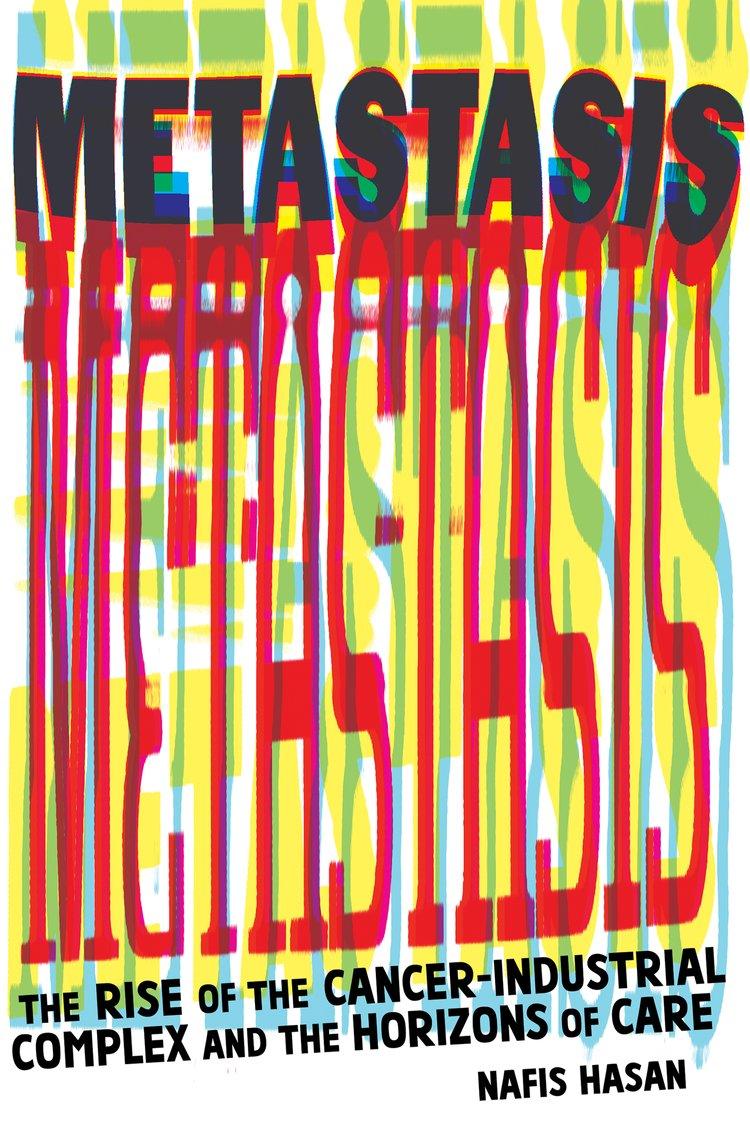
A bold rethinking of cancer as a biological phenomenon, an indictment of science that serves capitalism, and a radical vision of liberated health and well-being.
More than fifty years after the declaration of the War on Cancer, we are nowhere closer to victory. The problem lies in the way cancer is understood and the “cancer-industrial complex” that has been established to address it. The cancer-industrial complex arises from the symbiosis of private corporations, nonprofit organizations such as universities and foundations, and public governmental regulatory bodies in the post-genomic era. This network profits off a vulnerable population who exist in a market that is structurally rigged against them given their physical and socioeconomic conditions. Under the auspices of scientific research and technological progress, much of which is well-meaning, a critical extortion takes place.
Metastasis brings the cancer-industrial complex to the fore of our understanding of what cancer is, the chronic nature of the disease, its unmistakable parallels to capitalism, its inextricable link to the neoliberal model of economic development, and its disproportionate burden on nonwhite and poor populations—and what it will really take to rid ourselves of the gravest dangers to our individual and collective well-being.
Trained as a cancer scientist, Nafis Hasan offers a critical and clinical reading of current narratives of cancer research and the conditions that put the onus on the individual rather than our collective efforts to prevent cancer incidence and deaths. He offers a visionary alternative theory about carcinogenesis—one countering the dominant neoliberal idea of mutations causing cancer—and centers a dialectical approach to understanding the biology and sociology of cancer. Hasan states, “If we must fight the longest war, then it should be the war against capitalism, whose growth has metastasized in every aspect of our society and ourselves.”
Praise
“Cancer isn't just nature—as Metastasis shows, it’s a deeply social and historical disease, and one that our unequal and predatory social systems leave us ill-equipped to overcome.” —Gabriel Winant, author of The Next Shift: The Fall of Industry and the Rise of Health Care in Rust Belt America“Why do so many things intended to heal in fact kill? With skillful intellectual care, Nafis Hasan explains why, insisting we admit to ourselves that we are living (and working, and dying) inside a lucrative carcinogenosphere, and that things don’t have to be this way. To read Metastasis is to give up on firm distinctions between cancer, commodified cure, and capitalism, but also therefore to gain a visceral understanding of the real possibility of remission for us all—tomorrow, if not today.” —Sophie Lewis, author of Abolish the Family: A Manifesto for Care and Liberation and Enemy Feminisms: TERFs, Policewomen, and Girlbosses Against Liberation
“Through an unbiased historical and sociological analysis, Nafis Hasan perceptibly identifies the key events that allow us to unravel what has been called the ‘cancer puzzle.’ For over a century, the misplaced arrangement of pieces of this puzzle prevented a correct interpretation of scientific facts, the completion of successful clinical outcomes, and the enactment of beneficial public health policy. Metastasis is an important and timely contribution to the proper placing of those misplaced pieces into a pattern aimed to finally resolve the cancer puzzle, and open a horizon of care sorely needed.” —Carlos Sonnenschein MD, Professor of Integrative Physiology & Pathobiology at Tufts University School of Medicine and an International Fellow at the Centre Cavaillès, Ecole Normale Supérieure, Paris, France
Reviews
“Nafis Hasan’s new book Metastasis: The Rise of the Cancer Industrial Complex and the Horizon of Care cuts through the seeming inescapability of cancer and the “cancer industrial complex” by laying out a contemporary political history of cancer treatment in the United States, with a focus on how policymakers, medical associations, and pharmaceutical companies have worked to prioritize a framework of cancer as a primarily genetic disease rather than a disease caused by environmental factors such as pollution and dangerous working conditions.. The book is a quick and brutal read that lays out, in depressing and enraging detail, the history of our current cancer treatment industrial complex and the series of political and economic decisions made by the ruling class to bar providers of cancer treatment, advocacy organizations, and researchers from fully confronting how war, imperialism, pollution, and dangerous working conditions drive cancer rates.” - Democratic Left“Metastasis isn’t an easy read…Its style and density make Metastasis an imperfect book and its engagement with Marxist philosophy isn’t mainstream in US science writing. But it is also deeply necessary and illuminating. Most importantly, Hasan isn’t writing from a place of despair – the book ends with a call to imagine new horizons of care and start organising to reach them, even if they seem as distant as the stars.” - New Scientist
“Nafis Hasan provides a brave and insightful critique of the scientific industry and the systems that maintain the status quo. He offers a blueprint for healthcare organizers, patients, and workers—scientists in particular—to untangle and resist the cancer-industrial complex which continues to commodify the bodies of patients down to the microbiological level, routinize the scientific method, and commercialize scientific outputs for the pursuit of profit over people. Hasan grapples with the human, scientific and political elements of the cancer industry with compassion for those it harms. His book moves us toward a horizon to struggle for new ways of doing science, in service of people, public health, and health equity, not commercialization and profits.” - Spring Mag
“The book’s strength lies in exposing the links between seemingly distinct scientific, medical, and social spheres. But it is also original in its refusal to accept this state of affairs. Hasan underscores that defeating cancer requires nothing less than to challenge the power of capital… Hasan makes a powerful case for scientific workers to recognise their position among the working classes and mobilise to build collective power, to secure not just their livelihoods but the very integrity of their profession. He also traces a path for diverse struggles encompassing patient welfare, labor rights, ecological justice, and more, to find common ground to mobilize against the cancer-industrial complex. It is here that Metastasis showcases the breadth of Hasan’s expertise as a cancer biologist, dialectical scientist, critical theorist, and political organiser across multiple labor, ecosocialist, and radical struggles.” - Science for the People
Excerpts
“The idea that cancer may be a hereditary disease can be traced back to the early twentieth century. Around 1900, the biologists Theodor Boveri and Walter Sutton rediscovered Gregor Mendel's laws of biological inheritance and proposed that chromosomes were responsible for inheriting biological traits. Boveri later proposed that a tumor cell arose when cell division went wrong and chromosomes were improperly distributed. In Boveri's view, "the problem of tumors is a cell problem." This was perhaps the first conceptualization of the "cancer cell," a lone culprit that could wreak havoc in the body.” Read the full excerpt on Somatic Mutation Theory and Cancer at LiveScience“Every major armed conflict since World War I has created significant cancer clusters among both civilians and soldiers. The atomic bombs dropped on Japan resulted in a 660 percent increase in leukemia rates among survivors living near the detonation zone, even twelve to thirteen years after the bombing. Increased risks for several types of solid cancers are also observed among the same population to this day. Women exposed to the bomb radiation during puberty showed higher risks of developing uterine and breast cancers than those exposed before or after puberty. The radioactive fallout from nuclear weapons tests in the Marshall Islands between 1946 and 1958 also eviscerated the Marshallese from within––55 percent of all cancers among the Rongelap community are attributable to the radioactive fallout.” Read the full excerpt on War and the Cancer-Industrial Complex at CounterPunch

